
As a joint major in Environmental Studies and Conservation Biology at Middlebury College, I elected to pursue independent research in the form of an honors thesis from 2012-13. My research focused on assessing carbon storage in a bioenergy plantation, and I framed my research within the context of Middlebury’s carbon neutrality goals.
PROJECT BACKGROUND
In 2007, Middlebury College’s trustees adopted a resolution for the college to become carbon neutral by 2016. The following year, the college built an on-site biomass gasification plant to help in this effort. The facility would allow the college to replace the majority of its fuel oil consumption with locally sourced wood chips to burn primarily for heating, cooling, and cooking.
While the wood chips that Middlebury was burning came from within a 75-mile radius of campus, the college was interested in exploring opportunities to grow bioenergy in its own backyard for a more local, reliable, and economical source of bioenergy. So, Middlebury developed a partnership with SUNY-ESF to cultivate willow bioenergy plots on college-owned property and explore the feasibility of fueling its biomass gasification plant with the willow biomass — a fast-growing, dedicated energy crop with short harvest cycles and the ability to re-sprout after multiple harvests. The Middlebury Willow Plot had the dual purpose of identifying which willow varieties would have the highest biomass yields for higher energy procurement, as well as how various fertilization schemes might influence these yields.

Although the willow plots were deserted in 2011 after apparently demonstrating less-than-satisfactory results at the biomass gasification plant, I wanted to study the plots to distinguish between bioenergy crops that were optimal for the purposes of energy yield vs. the purposes of carbon mitigation — particularly through the storage of carbon over time in the soil, which is influenced by a number of actors such as the type of biomass growing in the soil, and historic and current land management practices. Long-term soil carbon storage is often what tips the scale towards bioenergy crops being considered carbon negative energy sources.
Here were my primary research questions:
- What is the carbon profile of Middlebury’s willow bioenergy plantation (i.e. how much carbon is stored in the different components of the system), and how does this profile change over time?
- How might willow type and fertilizer used influence this carbon profile?
- How does the carbon profile of the willow plantation compare to that of the adjacent hay field? I was interested in exploring this question because the hay field will likely be replanted with willow if Middlebury decides to pursue willow as a more permanent and local source of wood chips. I wanted to better understand to what extent adding willow to the hay field might change the hay field’s capacity to store carbon.
METHODOLOGY
The Middlebury Willow Plot featured two species of willow (one had thick stems but fewer of them, the other had thin stems but more of them) that had been previously treated under four different fertilization schemes (no fertilizer, biosolids compost, urea commercial fertilizer, digested dairy manure).
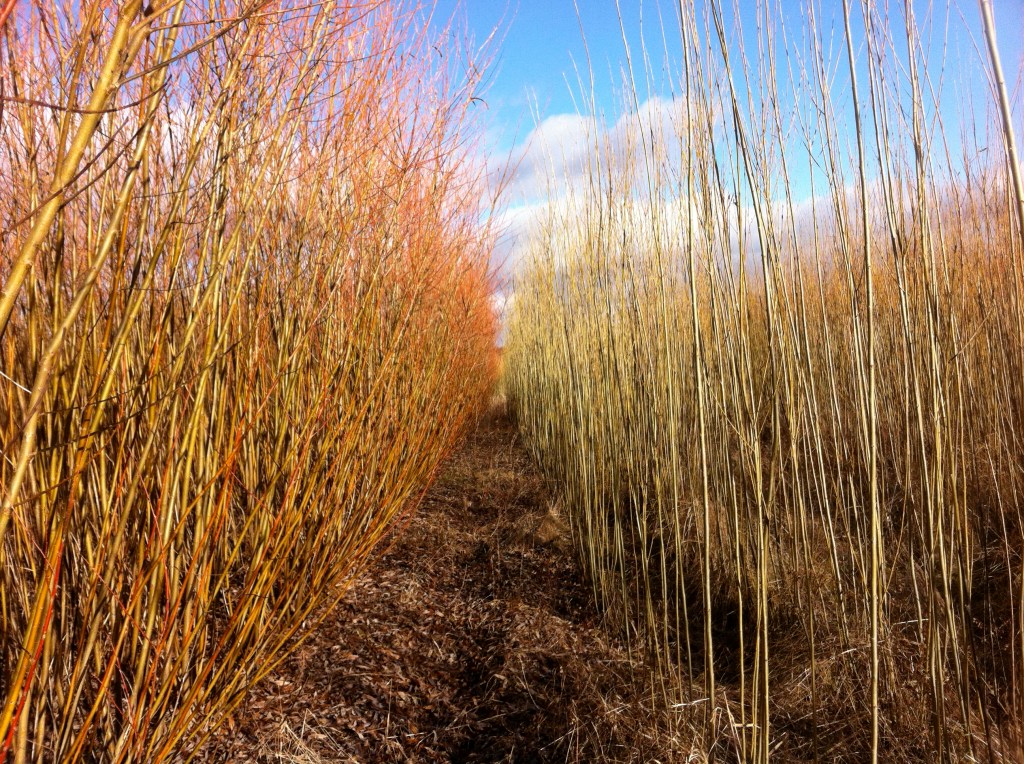
From each possible combination of species and fertilization scheme, I collected and analyzed the carbon content of samples of soil, live below-ground biomass (i.e. roots), and dead surface leaf litter. I also measured the mass of live aboveground biomass and used allometric equations to determine carbon content. I had two main sampling periods, one in Fall 2012 and the second in Spring 2013.
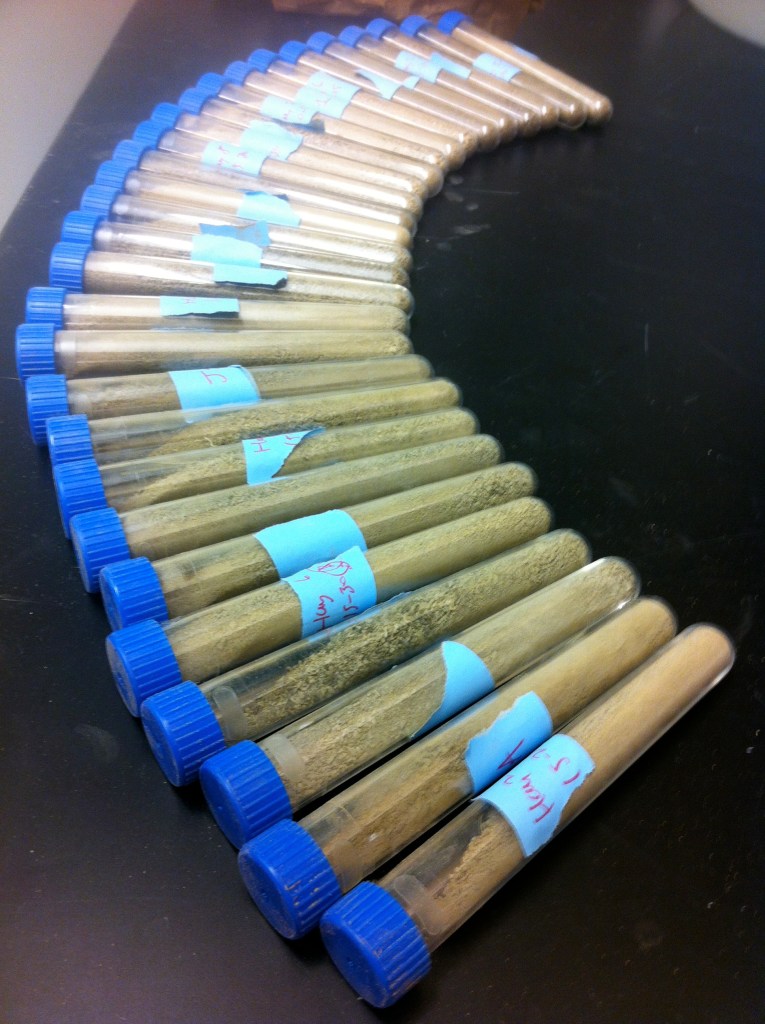
I also analyzed carbon content in the soil, live below-ground biomass, and above-ground biomass in the active hay field adjacent to the willow plots.
RESULTS
Soil was the dominant carbon pool across all sampling sites, which underscores the importance of proper soil management when managing carbon storage in bioenergy systems:

We can further structure our carbon storage results from the perspectives of:
Biomass type: We found a trend towards the systems with thicker willow storing more carbon than the systems with thinner willow; the thicker willow had the higher growth rate, which translated into greater above- and below-ground biomass. More biomass (especially belowground roots) means greater potential for greater soil carbon input over long periods of time. The implication here is that the thicker willow variety could allow Middlebury to optimize its bioenergy production for carbon mitigation purposes.
Fertilizer scheme: The biosolid compost system stored more carbon in soils. This suggests that the biosolids compost system could be another management technique to allow the college to optimize its bioenergy production for carbon mitigation purposes (as well as soil health).

Time: Within the roughly 8-month frame of our study, we weren’t able to observe statistically significant changes in carbon stored in the willow plots, suggesting that significant carbon storage benefits may take longer than 8 months to detect. Longer-term longitudinal studies on how carbon in soils change under short rotation woody crops such as willow are necessary.
Ecosystem type: We observed significant increases in carbon stored in the hay field between Fall 2012 and Spring 2013, suggesting that carbon storage may happen on a more rapid scale in the hay field when compared to the willow plots. An interesting future study would involve comparing the rate of change of carbon storage in the hay field to the rate of change in the willow plots over longer periods of time.

Changes in hay field biomass carbon from Fall 2012 to Spring 2013 
Changes in hay field soil carbon from Fall 2012 to Spring 2013
Overall, these preliminary findings can be used as a starting point to inform management decisions regarding the future development of the Middlebury Willow Plot.
** A quick postscript: Middlebury did end up meeting its goal of becoming a carbon neutral campus in 2016, and has since announced goals to transition to 100% renewable energy sources by the end of 2028 as part of its Energy2028 plan.
WHERE CAN YOU READ MORE?
You can read my thesis here.
 GILLIAN LUI