
In Summer 2008, I was selected to participate in the Stanford Earth Science Intern Program (since rebranded as Stanford Earth Young Investigators), my first field research experience.
Under the guidance of Jessica Shors, a then-Ph.D. student in The Gordon Lab at Stanford University’s Department of Biology, my intern cohort and I researched the impacts of invasive Argentine ants (L. humile) at the Jasper Ridge Biological Preserve. Argentine ants had been spreading across Jasper Ridge due to a range of factors including climate change and changing land-use regimes, and we were interested in better understanding their distribution within the reserve over time and the impact of their invasion on interspecific relationships within Jasper Ridge.
For example, in Jasper Ridge, the common acmon blue butterfly (P. acmon) shares a mutualistic relationship with native ants: native ants protect the butterfly larvae from parasitoid wasps, and the butterfly larvae in turn secrete a sweet dew for the ants to consume. Given the shifting distribution of Argentine ants within Jasper Ridge, some of our guiding research questions were: to what extent did Argentine ants fulfill the mutualistic role that native ants perform with the acumen blue larvae? Were Argentine ants affecting the survival of the acmon blue by leaving them vulnerable to parasitism? What degree of plasticity might there be in co-evolved ant-butterfly mutualisms?
My fellow interns and I spent the summer surveying Jasper Ridge for the presence of various ant species. In areas invaded by Argentine ants, we also set up experimental plots within which we seeded host plants with mature acumen blue eggs and excluded Argentine ants from accessing the eggs, to observe how the eggs would develop.
Ultimately, we contributed data to the Jasper Ridge Biological Preserve Ant Survey, which has occurred twice a year since 1991. The figure to the left below is a record of ant distribution across Jasper Ridge in Spring 2008, before our Summer 2008 survey data were added to the record, contrasted with the figure to the right of ant distribution in Fall 2015. In both figures, red dots represent plot areas in which Argentine ants were found to be present, while green dots represent plot areas in which Argentine ants were absent. You can see the increasing encroachment of Argentine ants further into Jasper Ridge over time.

Map of ant expansion into Jasper Ridge from a Gordon Lab presentation 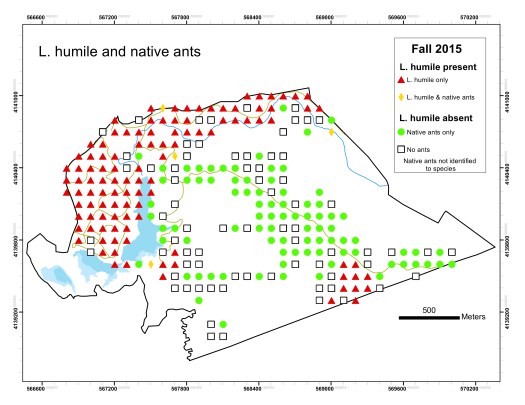
https://jrbp.stanford.edu/research/jrbp-ant-survey
Jessica details the results of our experimental plot work in her Ph.D. dissertation: in areas invaded by Argentine ants, more butterfly larvae survived to the final instar growth stage on control plants than on the experimental plants that excluded ants, with Argentine ants also preventing parasitism rates among the butterfly larvae. Our research indicated that Argentine ants were playing the role of “benevolent intruders,” mutualistically facilitating native butterfly survival in areas of their intrusion.
 GILLIAN LUI